Show your support: Donate Now


Support HRCBM: Please donate Now

$

Friday, November 29, 2013

Muslim mob vandalises 26 Hindu houses in Bangladesh

Source: The Financial Express

Summary: The attack was provoked after alleged reports of a Hindu boy committing blasphemy.

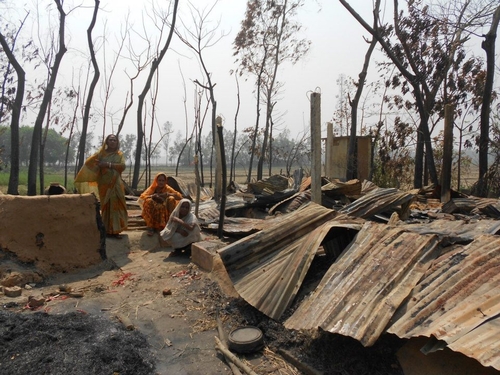
A Muslim mob burned down 26 Hindu houses in Bangladesh's Pabna district on Saturday. The attack was provoked after alleged reports of a Hindu boy committing blasphemy. (Reuters image)


A mob went on a rampage in a Hindu-dominated neighbourhood in a village in Bangladesh's Pabna district following reports that a boy from the minority community had committed blasphemy, prompting the country's High Court to order arrest of attackers within 24 hours.
The mob attacked the Hindu neighborhood at Bonogram village in Santhia upazila in Pabna district on Saturday, vandalising 26 houses, damaging several idols and forcing about 150 families to flee the area.
The incident prompted the High Court to take suo motu cognisance, asking the Inspector General of Police to ensure the arrest of the culprits within 24 hours and deployment of adequate police forces in the area to protect the minorities.
"We have arrested nine of the perpetrators of the attack in the past two days and are looking for the others," officer in-charge of the local police station Rezaul Karim said.
He said that most of the suspects belonged to supporters or activists of main opposition Bangladesh Nationalist Party or their crucial ally Jamaat-e-Islami while the scene was the home of the fundamentalist party's chief Matiur Rahman Nizami, who is being tried for 1971 crimes against humanity.
"The situation here is now normal," Karim said.
The High Court bench comprising judges Quazi Reza-Ul Hoque and ABM Altaf Hossain also asked the police chief to launch a probe into the attack and assess the amount of loss it caused and submit the report before the court.
The media reports, meanwhile, came up with a finding that a group of extortionists, mostly belonging to the BNP and their fundamentalist ally Jamaat-e-Islami, had planned to frame Hindu schoolboy Rajib Saha for maligning Islam after his businessman father refused to pay them.
The Daily Star newspaper said it found that the Facebook page, photocopies of which were used to incite the attacks, had no links with Rajib.

Attacks on Hindus: TIB for probe, punishment to culprits

Source: The Daily Star

Transparency International Bangladesh (TIB) has expressed concern over the attacks on minority communities and their places of worship in Lalmonirhat, Pabna, Rajshahi, Faridpur and Khagrachhari in the last few days.
In a statement yesterday, the anti-graft watchdog demanded a fair investigation into the incidents by a powerful judicial committee and exemplary punishment to the culprits.
It also demanded appropriate administrative steps to put an end to such barbarism in no time.
These attacks on minority communities are “against the spirit of the country’s Liberation War and independence,” TIB Executive Director Dr Iftekharuzzaman said in the statement.
In no way are these incidents acceptable in a Bangladesh committed to communal harmony and equal rights of all citizens irrespective of religion and race, he stressed.
“Attacks have been carried out on minority communities under the auspices of politicians and powerful persons centring on elections in the past. Similar attacks for intimidation and mean and destructive political purposes ahead of the next elections are never acceptable,” he added.
Iftekharuzzaman noted that the situation might take a grave turn if steps are not taken immediately, adding, “We are more concerned to know that those incidents are planned and motivated.”
The TIB urged the media and the concerned citizens to take a stand against such crimes.
Bangladesh Sonatoni Dhormio Sammilito Parishad, Bangladesh Jatiya Hindu Mohajot and Bangladesh Minority Sangram Parishad also condemned the attacks on Hindus and other minorities in different parts of the country.
Gono Forum will visit Santhia in Pabna to see the Hindu houses that were vandalised and looted last week, said a press release.

Bangladesh: Genocide Now, Taliban Soon

Source: American Thinker
Madeline Brooks

Bangladesh is on the road to becoming another Afghanistan, fulfilling the clearly stated desires of jihadists and fundamentalists, according to Bangladeshis who have fled their homeland.

Imams describe women as filth and demand that they cover themselves.  They accuse exploited female garment workers of prostitution when they are forced to work late into the night to earn a living.  Schoolchildren have to dress in Islamic garb, even if they are not Muslims.  Workers are discriminated against if they are other than Muslim.  Land grabs by Muslims of property owned by minorities occur all the time -- with impunity.  Atheist bloggers are beaten and even killed for "insulting Islam," and all this under the supposedly secular Awami League administration.

The Hindu empire once stretched from Afghanistan to Indonesia, before the Muslim invasions whittled it down.  According to Dr. Sachi Dastidar, professor of politics at the State University of New York at Old Westbury, Long Island, forty-nine million Hindus are missing from the Bangladesh census over the period of 1947 to 2001.  At the time of the partition of India in 1947, Hindus comprised thirty-one percent of the population of Bangladesh.  The population of Hindus in Bangladesh is now down to a mere nine percent.  The numbers are shrinking very fast due to coerced conversions; the kidnapping of girls and women, as well as rapes followed by murder; forced flight -- and genocidal massacres.

In the near future, all the non-Muslims may be "ethnically cleansed" from Bangladesh.  The world will have lost one more part of the globe to fundamentalists and gained one more staging ground for new attacks on the West.

The minority population in Bangladesh lives under constant fear of loss of life and property, especially in the countryside, where Muslim transgressions more easily escape being publicized.

Imagine this: You are a peasant farmer living in a thatched house in a remote area.  You and your brother try to keep a vigil during the night, expecting another raid, since there have been frequent attacks on your neighbors.  Men with torches come at three in the morning and set fire to your house, after dragging out your wife and two daughters, ages nine and thirteen.  You must fight alone, because your brother was mutilated by the same men in a previous raid.  All his fingers were cut off, and his right leg was amputated at the hip so that he would suffer lifelong humiliation as well as disability.

You are beaten and bound, forced to watch the gang-rapes of your wife and daughters.  Your house and all your possessions are burned beyond use.

Your wife and daughters are afraid to file a complaint with the police, because they know that the police usually do not prosecute the attackers -- and they may even turn on the victims.  (All this, to say nothing of having to bear the shame of being sexually violated.)  You have talked with your neighbors about mounting a stronger defense against the frequent attacks, but all of you feel demoralized, knowing that scores or even hundreds of armed men have descended on others like you to punish you for having the temerity to fight back. 

You consider fleeing with your family but do not want to give up the land that has belonged to your ancestors for hundreds of years.  But if you stay on your land, which is the only life you know, you may very well be killed. 

Such is life today in Bangladesh for Hindus, as well as for all the other minorities: Buddhists, Christians, atheists, and animists.  The details of this sketch are all too real.  They were culled from photos and verbal descriptions of the persecution of the minorities compiled by a human rights organization of Bangladeshi Americans, the Bangladesh Hindu Buddhist Christian Unity Council.

The Bangladesh Unity Council will meet on November 20, 2013 in Washington D.C. with the House Committee on Foreign Affairs.  Hopefully this time they will see results, since the same group has been meeting with other U.S. officials since 1999 without any sign of improvement.

An immediate concern is the upcoming national elections in Bangladesh, because in this aspiring democracy, ironically, elections bring fresh new pogroms against the minorities.

This is not to say that every Muslim in this Muslim-majority country participates in or accepts these atrocities.  On the contrary, there are Muslim intellectuals who write frequent articles decrying their country's slide toward sharia and jihad.

The international press, however, has barely noticed Bangladesh's descent into fundamentalist hell, and the threat it poses to world security. 

Worldwide attention and political intervention may be able to help slow down this disaster.  But that takes time.  Most immediately, however, support is needed to stop the ongoing genocide.  To meet immediate needs for survival, non-violent physical assistance to protect endangered communities must be considered.

Madeline Brooks is a counter-jihad activist and writer, based in New York City.  She can be reached at ResistJihad@aol.com.

US lawmakers express concern over attack on minorities: Bangladesh

Source: Z NEWS

Washington: Expressing serious concern over increasing attack on religious minorities like Hindus in Bangladesh, top US lawmakers have said they are worried that the country is falling into the lap of fundamentalist groups.


During a Congressional hearing, the lawmakers urged the Bangladeshi government to take immediate steps to prevent the country from slipping into hands of fundamentalist groups.

"In Bangladesh today, if we go back to 1947. You have a total of 49 million Hindus missing from the rolls, many of them of course went to India. But recently we have got a situation where you got 1500 Hindu homes, 50 Hindu temples burnt to the ground," Congressman Ed Royce, the Chairman of the House Foreign Affairs Committee, said during hearing.

Not just Hindus, but people from other religious minorities including Christians are increasingly becoming victims of this attack, he alleged.

Royce said it is because a small percentage of Bangladeshi population has been radicalised and has not been given a wider broader education.

"I am particularly concerned over issues regarding religious freedom, and specifically, over attacks on the minority Hindu community remaining in Bangladesh today," said Congresswoman Tulsi Gabbard, the Acting Ranking Member of the House Foreign Affairs Subcommittee on Asia and the Pacific.

"It is up to the Government of Bangladesh to act authoritatively against those who incite and commit violence against anyone and protect the rights of all minorities," she said. "This is an essential step toward ensuring the safety and basic rights of all of Bangladesh's citizens, regardless of their faith."

Congressman Brad Sherman expressed serious concern over the violation of human rights of Hindus in Bangladesh.

Royce alleged that fundamentalist groups in Bangladesh are indulging in forced conversions by kidnapping girls and women and by showing terror.

"We also have a situation where in the local police sometime blame the Hindu population for destruction," he said.

"Unless the State in Bangladesh is ready to come forward and close these particular Deobandi schools, Bangladesh is going down the path where the consequences of this would eventually engulf itself. You can see what is happening in Pakistan, when you do not confront it," Royce said, adding that the Government is not doing enough to protect them.

Responding to questions from lawmakers, Ali Riaz, Public Policy Scholar from Woodrow Wilson Center, conceded that the issue has not been addressed as robustly as it should be.

"Instability in Bangladesh is contributing to this kind of situation. The State has never done it should be doing (to protect minorities). Irrespective of the political parties in power, the State has failed to protect the minorities," he said.

The lawmakers said that Bangladesh was currently in a state of political turmoil and attributed this mainly to the political stalemate between Prime Minister Sheikh Hasina and the opposition leader Begum Khalida Zia.

"As Bangladesh approaches national elections, which are likely to take place in early January the country is in a state of political turmoil," Congressman Steve Chabot, Chairman of the Subcommittee on Asia and the Pacific of the House Foreign Affairs Committee, said during the hearing.

"As the major political parties' ramp up their campaigns, operatives utilize riots, strikes and blockade to destabilize the country and call attention to their grievances," said Chabot, who had visited Bangladesh a few weeks ago during which he met both Hasina and Zia.

Insisting that the national elections should be free and fair, transparent and without violence, Chabot rued that both leaders were adamant in their positions.

"Sheikh Hasina insisted that the provisions were in place to conduct a fair election. Madam Zia held the position that a fair election could not be held without a caretaker government in place to ensure transparency. As of today, the two side remain at large and it is still uncertain whether or not the opposition BNP would boycott the election," Chabot said.

Any further violence, he cautioned would lead to strengthening of extremist groups in the country.

"The US continues to be concerned about the political deadlock between the two major political parties, in particular around the upcoming elections and the increase in violence that this deadlock creates," said Gabbard.

"Our Assistant Secretary for South and Central Asia Nisha Biswal just returned from Bangladesh and reiterated the US' position that the opposing parties must come to an agreement over the elections to ensure that there is a prevention of any further violence," she said.

"We hope that both parties engage directly in a constructive dialogue in order to create this environment for free, fair, and credible elections to occur. I think that this will be a critical measure as we look at US-Bangladesh relations moving forward," Gabbard said.

Testifying before the committee, eminent experts expressed concern over the political stalemate in Bangladesh and cautioned that the country could very well head towards an uncertain phase of efforts were not made to resolve this.

Maj Gen A M N Muniruzzaman, president of the Bangladesh Institute of Peace and Security Studies, warned that there is greater chance of post poll violence in case of an one-party election, which might spread across the border.

How Islamists Stole a Congressional Hearing

Source: American Thinker

Oppressed Hindus from Bangladesh asked for a congressional committee hearing to make known their victimization by Islamists.  They got their hearing, but they were not given a chance to speak; instead, Islamists took over.

Not one Hindu was invited to be on the panel of speakers.  The Islamists trashed the only political movement in Bangladesh that offers some hope of secularism.

Evidence suggests that an American lobbying firm working for a Bangladeshi war criminal bought influence with the hearing.  The same day, the NY Times wrote a staggeringly pro-Islamist editorial, raising the question that perhaps they too were bought with lobbyist money.

On November 20, 2013, a group of loyal Hindu Bangladeshi American citizens were granted a long-awaited hearing by the U.S. House Foreign Affairs Committee.  The Hindus wanted to ask the U.S. to stay the hand of the religious extremists who are pushing their compatriots remaining in Bangladesh toward genocide, described more fully here.

Bangladesh is erroneously considered a moderate Muslim country by the State Department.  Hindus and other minorities -- Buddhists, Christians, animists, and atheists -- live in continuous anxiety, even terror.  Minorities have scant protection against Islamist depredations such as murder, rape, and burning of their houses and places of worship, as well as theft and discrimination in the Bangladeshi legal system.  Protection from the police is uncertain, since Bangladeshi police often either ignore minorities' complaints or are themselves the perpetrators.  This land, which was once solely inhabited by Hindus and Buddhists, now has a minority population of non-Muslims of only about nine percent.  Mass murders, forced conversions, and forced flight account for the drop in numbers.

Right now is an especially frightening time for Bangladeshi minorities, because elections will happen soon.  Historically, that has always meant heightened danger, with Muslim mobs attacking vulnerable minorities no matter what the outcome of the election might be. 

Two major forces vie for control of Bangladesh: secularists and Muslim fundamentalists.  The incumbent party, the Awami League, is nominally secularist and offers some hope for minorities.  Opposing it is the Bangladesh National Party, allied with a group called Jamaat-e-Islami, which wants to impose a totalitarian form of Islam on everyone in that country.  In the 1971 war of liberation, Jamaat was involved in war crimes against Bangladeshis, especially Hindus, who wanted freedom from Pakistan and Islamic fundamentalism.

The AL is currently conducting trials of the war criminals, which the BNP objects to on procedural grounds.  While some of AL's judicial practices may be questionable, at bottom, the BNP wants to spare their Jamaat affiliates from possible execution for their past deeds.  The AL views Jamaat as a potential disaster for democracy, much as we would if al-Qaeda were included in our elections, and is trying to keep Jamaat out of the electoral process.

Whatever its flaws might be, the AL is the only present-day bulwark against the Talibanization of Bangladesh. 

The contentious issue of the war crimes tribunals so dominated the House Foreign Affairs Committee hearing that the problem of spreading Islamism and the persecution of minorities received short shrift.  Although the BNP members did mention minorities in passing, not one Hindu or other minority was on the panel.  The drift of the BNP position was that by excluding Jamaat, there would -- somehow, mysteriously -- be disturbances which would destabilize the country and affect minorities, too.  BNP sidestepped the intolerance and disrespect for non-Muslims that is the root of the problem.  It was a bizarre and revolting reversal of justice.

The hearing appears to have been hijacked.  Hindu activists believe that a strong BNP lobby is operating in Washington.  It is already established that a major lobbying firm, Cassidy & Associates, represents war criminal Mir Abdul Qasim Ali (pictured left), who is held in custody in Bangladesh awaiting trial and possibly execution.  Ali was implicated in a wartime killing spree and is a major fundamentalist player.  He is a senior member of Jamaat who supports Wahhabist values, and he heads a Saudi-based bank that launders money for Jamaat and terrorists. 

Gregg Hartley (pictured right), vice chairman and CEO of Cassidy & Associates, has been conducting a publicity campaign in Europe and the U.S. to get Ali released from jail, according to his home-state newspaper, the St. Louis Post-Dispatch.  Disclosures of lobbyist records show that Cassidy and Associates has received more than $500,000 in the past year from Ali and his very wealthy family. 
Hartley's battle to free Ali involves discrediting the purpose as well as the methods of the war crimes tribunals, thereby legitimizing Islamism and its abuses.  Hartley also lobbies for Pakistan and other Islamist clients, as stated on his firm's website. 

Apparently Hartley does not object to working for Islamists, even if they would limit his own freedom if they came to power in the U.S.

An inescapable question arises: was a paid campaign waged to discredit the war crimes tribunal at the Foreign Affairs hearing in order to spare Hartley's client?  Were Hindus kept off the panel so that they could not give evidence of the complete Islamist take over Bangladesh is facing, and of the persecution that minorities are suffering even now?  This is a very reasonable speculation, and an investigation of Cassidy's activities and finances is in order.

A similar question must be raised about the alarming editorial in the NY Times published on the same day.  The Times lays the blame for Bangladesh's growing instability solely on the AL and states that Jamaat should be legitimized by including it in the upcoming elections.

Remember that Germany voted the Nazis into power.  A similar fate could await this vulnerable country, already teetering on the brink of totalitarian Islam.  One has to wonder why the NY Times took such a disastrous editorial position. 

Madeline Brooks is a counter-jihad activist and writer, based in New York City.  She can be reached at ResistJihad@aol.com.

Minority Hindus Targeted in Bangladesh

Source: GateStone Institute
url: http://www.gatestoneinstitute.org/4058/hindus-bangladesh

The leading newspaper in Bangladesh, the Daily Star, found that the page used to incite the attack had no links to the boy. The Additional District Magistrate to the jurisdriction stated that no one had found any substance to the claim made against the schoolboy.
The US Embassy expressed its "deep concern" about the recent attacks on Hindus and urged the Bangladeshi government to take action against the criminals and protect the rights of minorities.


Hundreds of Islamists recently stormed 26 homes belonging to minority Hindus in the Bangladeshi sub-district Santhia, and more in other areas. On the morning of November 2, 2013, a group of Islamists began distributing photocopies of what they claimed was a "Facebook page." They accused a Hindu boy, Razib Saha, who was preparing for a Secondary School Certificate examination, of demeaning the Prophet Mohammad on that page. An hour after distributing the photocopies, the Islamists caught the father of Razib Saha at his shop and beat him. They then attacked and vandalized houses in the Hindu neighborhood, destroyed two shrines, damaged several idols and forced 150 families to flee the area.
Meanwhile, protesting against the supposed defamation of the prophet Mohammad, for five hours people from different villages blockaded the highway that runs through the area.
The leading newspaper in Bangladesh, the Daily Star, found that the page used to incite the attack had no links to the boy. The Additional District Magistrate of the jurisdiction stated that no one found any substance to the claim made against the schoolboy.
In another incident, a group of masked criminals attacked 18 shops belonging to members of the Hindu community in a rural area in the district Lalmonirhat. The attack was allegedly launched by the main opposition party, BNP, and its crucial ally, Bangladesh Jammat-e Islami, the largest Islamist political party.
Hindu women in Banshkhali Upazila, Bangladesh surveying the remains of their demolished homes after being attacked by the Bangladesh Jamaat-e-Islami. (Image source: globalvoicesonline.org / WikiMedia Commons)
The US Embassy expressed its deep concern at the recent attacks on Hindus in both the areas and urged the Bangladeshi government to take action against the criminals and protect the rights of minorities.
Transparency International Bangladesh, a body of the Berlin-based Transparency International, also expressed its deep concern about seven incidents that have taken place over the last few days. It said, "Onslaughts and intimidation on minorities for ill and destructive political purpose before the election are not acceptable."
According to Hindu community leaders, so far, more than 50 Hindu temples and more than 1,500 Hindu homes were destroyed in 20 districts in 2013 alone.
Community leaders claimed that the Jihadi groups responsible for these attacks are funded by Hefajat-e-Islam, Jamaat-e-Islam and BNP. The president of the Bangladesh Hindu Buddhist Christian Unity Council said, "Conspirators are out to create a situation so that the Hindus can be attacked."
There is a commoniy cited statistic that the Hindus of the country are roughly 8.5% of the population, but since 2001, the Hindu minority population of the country is noticeably vanishing. They have, however, been supporting the Bangladesh Awami League, the party that led country's liberation struggle in 1971 against Pakistani occupation, and the leading party of the current alliance government.
The Awami League maintains good ties with India, a predominately Hindu country. The Party is considered a secular one, likely not to the liking of the millions of fundamentalists of the country.
Moreover, the government has initiated an International War Crimes Tribunal, in which nine members of the Jammat-e-Islami and two top BNP leaders have already been convicted for war crimes, and sentenced to life in prison or death.
The country is currently in deep political turmoil on the issue of election, scheduled for January 24, 2014.
It is a threatening situation for minorities, with the country's Islamists repeatedly using the Quran and the name of the Prophet Mohammad as tools to incite the massive and combustible Muslim community.
In the last year, an estimated 25,000 Islamists attacked 12 Buddhist temples and monasteries and 50 homes in reaction to the alleged tagging of an image, supposedly depicted as a "desecration of Quran," in the Facebook profile of a young man. Subsequently, several Hindu temples were destroyed and the violence spread.

Friday, November 22, 2013

BJP meets Bangladesh envoy over attacks on Hindus

Source: Z NEWS

New Delhi: A Bharatiya Janata Party delegation Wednesday met Bangladesh High Commissioner Mahbub Hassan Saleh and lodged a protest over attacks on Hindus in that country.

The delegation was led by BJP's convenor of overseas affairs Vijay Jolly.


"He (Jolly) pointed out that the minority Hindu community in Bangladesh today lives in the shadow of fear," a statement released to the press said.

"The Hindus in Bangladesh are regular victims of communal violence. Desecration of Hindu deities in Bangladesh is reported in the media repeatedly. Hindu families are identified, targeted, threatened and forced to convert," the statement said.