Show your support: Donate Now


Support HRCBM: Please donate Now

$

Wednesday, February 24, 2010

Bangladesh imposes curfew after riots

Source: IANS
web: http://www.indiatalkies.com/2010/02/bangladesh-imposes-curfew-riots.html


Bangladesh imposes curfew after riots

Dhaka, Feb 25 – Authorities in Bangladesh imposed a fresh night-time curfew in its south-eastern Khagrachhari hill district following riots between rival ethnic groups, officials said.

‘Night-time curfew between 2200 hours (2130 IST) Wednesday and 0700 hours (0630 IST) Thursday will remain in force,’ chief administrator of the district Mohammad Abdullah, told DPA.

Troops had remained deployed to prevent any trouble, he added.

Soldiers and police earlier launched a crackdown in the Khagrachhari hill district following riots between ethnic minority people and Bengali settlers.

They arrested 55 people allegedly involved in Tuesday’s violence, which left at least 15 people injured and several homes torched, additional police chief of the district Amir Jafar said.

‘The drive against the criminals is underway, and the ban on all sorts of gatherings remains in force,’ he said.

A total of 94 families were affected by Tuesday’s arson attacks, officials said. Ninety-two homes were completely burnt down while two others were vandalised.

The victims were being forced to sleep in the open and had no food, Chaithoai Marma, a tribesman, said.

The streets were mostly deserted and businesses were shut, said one resident from the district centre, some 275 km south-east of Dhaka.

Khagrachhari is one of the three districts in Chittagong Hill Tracts, home to at least 12 ethnic minority groups. Long-standing animosity exists between indigenous communities and Bengali settlers in the area.

The region was battered by insurgency for over two decades until a peace deal was signed between the government and the Parbatya Chattagram Jana Sanghati Samiti, a political party of the indigenous people, in late 1997.

State Minister for Home Affairs Shamsul Haq Tuku has toured the area and promised relief assistance to the victims, most of whom were said to be from ethnic minorities.

A Glimpse of Khagrachari incident

Note: The following pictures shared by Ratana Chakma at Facebook.
Please visit http://apps.facebook.com/causes/313616?m=7099fba7 and view more albums about Kagrachari incidents.


Late Update on Khagrachari incident

Source: PCJSS

24 February 2010, 9.25 pm

1. In the morning of 24 February 2010 a GoB Team including the State minister of Home Ministry, the State minister of Law ministry and the State minister of MoCHTA visited Bagaihut and gave assurances of proper rehabilitation and punishment of the culprits.

2. In the afternoon, they held meeting in Khagrachari Hill District sadar and along with them Jatindra Lal Tripura, MP and Chairman of the Task Force on Rehabilitation of Refugee Returnees and Internally Displaced Persons spoke there. Particularly the State Minister of Home Ministry stated that the incidents of killing, arson and looting at Baghaihut and Khagrachari were not desirable in a democratic and independent country of Bangladesh. It was possible only by the Pak Raider Army. Those who were Anti-Accord and War Criminals they committed the said heinous act.

It is learnt that it created sharp reactions among the fundamentalist communal elements and held a secret meeting and took decision to oppose it through committing further communal riots.

3. The RAB and the local army rounded up Jumma villages since the morning of 24 February 2010 and arrested many Jumma boys and persons including innocent ones from Khagrachari sadar areas.

The matter was placed to the local MP J. L Tripura, raised the issue with the Region Commander of Khagrachari. The Commander denied it and falsely argued in favour of the action. as a result, they had exchanges of hot words.

During the last night, the Jumma people guarded their villages at Khagrachari sadar. Particularly the Tripura People protected their villages, named Khagrapur other surrounding villages for which the settlers could not enter to their villages at all.

4. In Dighinala of Khagrachari a meeting was held in the afternoon and decision was taken to improve the situation. Until now no report of untoward incidents received from there.

5. On the contrary, the Commanding Officer of the Harina army Camp in Barkal Upazila in Rangamati Hill District instructed today for not going to Harina Bazar, suspecting communal attack. It indicates that situation may deteriorate there also.

6. Most importantly, it is noted that Bangali Chhatra Parishad is to hold rally tomorrow. If it is held, the communal forces may have the chance to avail it through committing communal riots at Rangamati town also. Therefore, it is necessary to consider whether 144 would be imposed there for tomorrow (25 Feb).

7. To-day Bengali people searched buses plied from Rangamati to Chittagong –Dhaka at Ranirhut and Raozan of Chittagong Hill District to find out Jumma Persons.

8. Latest Development

1) Arrest of Jumma people by army at Khagrachari sadar

After the visit of the GoB Team the army troops rounded up Jumma villages including those of the Tripura ones and apprehended some youths falsely accusing culprits. As a result, the Jumma males had to flee away from their houses and villages leaving their family members unprotected.

2) Attempts of Attack near CHTDB Rest House

Around 7.00 p.m. a group of settlers moved toward CHT Development Rest House Area situating on the eastern part of Khagrachari Town, where Jumma families including some PCJSS leaders including Sudha Sindhu Khisa (a member of CHTRC also) live. The RAB resisted them.

3) Attempts of Attack at Modhupur

Around 7.30 p.m. another group of settlers made attempts to raid the Madhupur Village. Owing to presence of Police they had to retreat from there at that moment. Suspecting further attack with more manpower the local leaders asked the Police authority to increase the strength.

4) Attack on Aparna Chowdhury Village of Golabari Mouza

Around 8.00 p.m. the settlers attacked Aparna Chowdhury Village of Golabari, Mouza, a Marma village situating on the south part of the Khagrachari sadar and till 10.00 p.m. it has been found flaming.

It is not known whether other villages have been exposed at the moment.

9. Conclusion:

It is apprehended that the settlers would fell upon many other villages at Khagrachari sadar this night and it may even encourage the settlers to commit riots at other areas.

In these circumstances, some immediate steps including strong order to Army Region to stop the rioters and to take up the step of transferring concerned commanders and civil Officers.

In order to stop taking advantage of falsely arresting Jumma persons only pass order to postpone any kind of arrest at the moment.

*****

Update of Khagrachari Incidents

Source: PCJSS

24 Feb 2010 Morning

1. Occurrence of the Incidents on 23 February 2010

UPDF, protesting the communal attack upon the Jumma People in Bagaihut on 19 and 20 February 2010, gave a call for strike in Rangamati and Khagrachari Hill Districts of CHT.

Astonishingly a group of 50-60 boys of UPDF around 9.00 a.m brought out a procession from Khabang Pariya area and proceeded toward Shapla Chattar at Khagrachari Sadar. The demonstrators had sticks and marble etc throwing device and shouted slogans excitingly. On the other, Bengali settlers from various cluster villages at Khagrachari Sadar and outside areas too came out in hundreds at that time with ulterior motives and got assembled at Khagrachari Shapla Chattar and other different points like Khagrachari Bazar, area and office areas. Clashes held between the two groups.

Considering the aggressive attitude of the settlers some Bengali leaders mainly belonging to Awami Leage had talks with UPDF leaders at Shapla Chattar about mitigating the tensed situation there. The UPDF leaders got agreed to stop their protests and close down the picketers from Shapla Chattar and other points to avoid clashes with the Bengali settlers. Gradually the UPDF activists got closed and the Bengali settlers being in larger numbers got control of the whole areas at Khagrachari Town.

2. Arson, looting and Killing

Around 11.00 a.m. Bengali settlers commenced their movement toward different directions and areas. Most of the Jumma people, suspecting communal riot of the settlers as well as intimidation from army troops vacated their homes, which created advantage for snatching and looting of goods.

One group commenced their movement from the Shapla Chattar to the Khagrachari Bazar. On the other, most of the Jumma villagers being frighten of communal riots and intimidation of the army as usual vacated their homes. While the Bengali Settlers group was passing the Mahajan Para rumour got spread that army troop was proceeding toward there. All Jumma boys and persons fled away for safety and security. A group of Bengalis of 7/8 persons suspected including army personnel in civil dress poured out petrol and set fire at the house of a Tripura person named Bir Bikram Roaza s/o Birendra Roaza (65) at Mahajan Para village. Then the fire gulped houses one after another. This group of settlers set fire on some shops of the Jumma persons at Khagrachari Bazar area.

Around 12.00 pm another group of the settlers numbering to 20/25 persons proceeded toward CHT Development Board Rest House looted houses and took snatched away ornaments from the Jumma women.

A big group of the setters followed by army patrol party proceeded toward Modhupur and Milanpur and set fire to one house of the Jumma people at first village and two houses of Jumma People at the second village.

Another group of the settlers attacked Satbheiya Para (Seven Brothers Village of the Marma People), which is situated at the outskirts of the Khagrachari Sadar and burnt down 37 houses. In one clash near that village a rioter named Anowar Hossain, gardener of Khagrachari Pourasabha office reported killed.

3. Steps of the GoB

The situation was suspected to be out of control and communal riots would get enhanced at night. The Jumma People from various corners urged the higher authorities in Dhaka including PM Sheikh Hasina to take proper and stern steps.

In the evening one AIG of Police was deputed in Khagrachari and section 144 was imposed.

At night around 10.00 p.m. RAB was reported deployed and curfew imposed in Khagrachari Town till 7.00 a.m. of 24 February 2010. Situation in Khagrachari Town came under control at it.

4. Tension at other places

On 23 February 2010 Bengali settlers under protection of the army troop of Baghaihut Army Zone Camp set fire on the Clinic of the MSF, an International NGO at Baghaihut in Kassalong Reserve Forest in Sajek Union under Bagaichari Upazila in Rangamati Hill District.

Tension loomed large at other different places like Panchari Upazilla and Dighinala Upazilla in Khagrachari Hill District and Langadu Upazilla and Kawkhali Upazilla in Rangamati Hill District.

In Rangamati Deputy Commissioner Sourendra Nath Chakraborty held a meeting in the evening of 23 February where representatives from CHT Regional Council and Rangamati Hill District Council, Rangamati Army region, BDR and Police got attended. Decision was adopted to resist any kind of untoward incident in the district.

At night police forces were deployed at important points. Some settlers made attempts to create chaos at a few points like Vedvedi and Tribal Adam of Rangamati Town. The Police resisted them properly.

24 February 2010

11.00 a.m.

1. Operation of RAB etc. at Khagrachari sadar Areas

In the morning around 7.30 a.m. of 24 February 2010 RAB (Rapid Action Battalion), local Police, BDR and Army reported rounded up Khabangpajya village and Swanirbar Area, a stronghold of the UPDF and apprehended some Jumma boys and persons. It created chaos and the local school reading boys and girls got trouble to get out from homes for their examination there today. Their guardians asked the District Administration and other concerned authorities for relaxation of the operation for their children. The matter was raised to the local MP Jatindra Lal Tripura also. Till 11.00 a.m. it is not known whether any one got failed to go to the Examination Hall in Khagrachari town due to the situation.

2. Dead Body of Anwar Hossain, a rioteer

On the other, it is reported that the dead body of Anwar Hossain, a rioter would be buried today at afternoon. There is apprehension whether, the Bengali settlers would bring out any rally carrying it, which may create serious tension and communal riots as well may come up once again there.

3. Conclusion

It is noted that normal situation is yet to resume for which most of the people particularly the Jumma ones are having confined themselves in their houses. So, it is difficult to have proper and full reports of the occurrences.

Call for protest on the communal attack against indigenous people of CHT: Invitation from various organizations

Appeal from Kapaeeng Foundation

Dear all,
The civil society groups of the country are going to organise protest meeting against beinous killing, land grabbing, arson and communal attack on indigenous peoples in Baghaihat in Rangamati and Khagrachari on 25 February 2010 at 10.00 am Thursday at central Shaheed Minar in Dhaka.
On behalf of Civil Society Groups, Kapaeeng Foundation invites all of you to attend the meeting, if possible, with banner.

Kapaeeng Foundation

Bangladesh: Tribal people killed and villages burnt in army and settler attack

Source: Survival International Report
http://www.survivalinternational.org/news/5581


Reliable sources report that at least six Jumma tribal people were killed, and hundreds of houses burnt to the ground, in an attack by soldiers and settlers on tribal villages in the Chittagong Hill Tracts of Bangladesh on Saturday. The attacks took place in the Sajek region, where tensions have been rising since Bengali settlers, supported by the army, have been expanding their settlements on Jumma land.

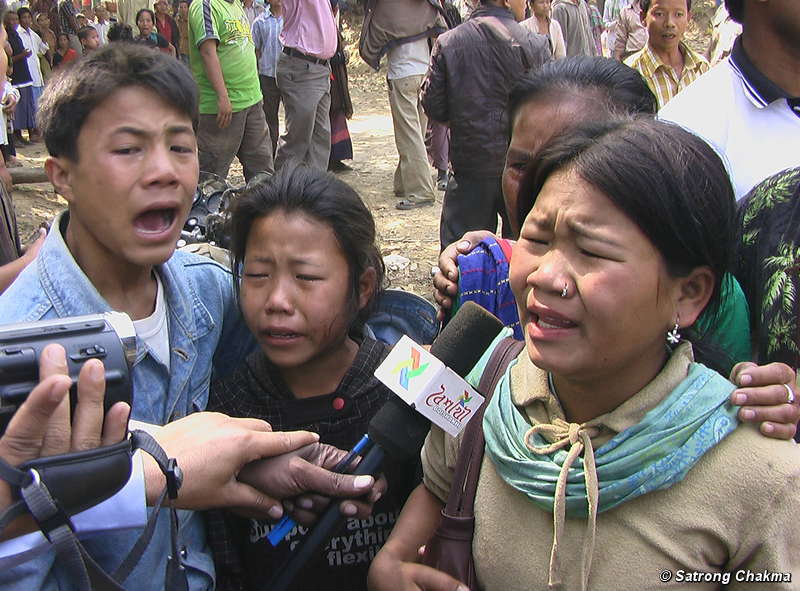
The children of Ms Buddhapati Chakma, who was shot dead by soldiers, speak to local journalists.
Picture (courtesy: Survival International): The children of Ms Buddhapati Chakma, who was shot dead by soldiers, speak to local journalists.
© Satrong Chakma

Local reports state that soldiers shot indiscriminately at Jumma villagers after one soldier was injured during clashes. Many other Jummas were hurt. Settlers, aided by the security forces, set fire to, and destroyed, five villages, consisting of at least 200 houses. A Buddhist temple and a church have also been burnt down. Thousands of Jummas have fled to the jungle to escape from the soldiers and settlers.

The local administration has imposed an order known as section 144, which prohibits the assembly of five or more people and the holding of public meetings. This is hampering the Jumma’s efforts to establish the whereabouts of missing people and to confirm the numbers killed. Two bullet-ridden bodies have been recovered (those of Mr Lakkhi Bijoy Chakma (40) and Ms Buddhapati Chakma (36)), but tribal leaders report that the army has removed the bodies of several other Jummas who were killed during the incident.

Hundreds of thousands of settlers have been moved into the Hill Tracts over the last sixty years, in a policy supported by successive governments, displacing the eleven Jumma tribes and subjecting them to violent repression.

In 1997 the government and the Jummas signed a peace accord that committed the government to removing military camps from the region and to ending the theft of Jumma land by settlers and the army. The accord offered hope, but military camps remain in the Hill Tracts and violence and land grabbing continue.

Survival’s director, Stephen Corry said, ‘This horrific incident is just the latest in a long line of brutal attacks on the Jumma tribal people. They have been killed, tortured and raped, and their lands stolen, for far too long. We call on the government of Bangladesh to put an end to army violence in the Chittagong Hill Tracts and to withdraw the army camps, as promised in the peace accord. Those responsible for this atrocity must be brought to justice.’

Note to editors: Survival has pictures from the incident.
Contact Miriam Ross: mr@survivalinternational.org

Note to UK editors: Jumma people living in London will protest outside the Bangladesh High Commission on Wednesday 24th of February at 10 am.

Ethnic Violence Grips Bangladesh

Source: Asia Security Initiative blog, MacArthur Foundation
http://asiasecurity.macfound.org/blog/entry/111ethnic_violence_grips_bangladesh1/


On February 23, Dhaka authority deployed troops in the south-eastern Khagrachhari district (Chittagong Hill Tracts) after clashes between ethnic tribal people and Bengali settlers left at least 15 people injured and several houses torched. Earlier, similar violence took place in Rangamati district on February 19-20.

The Asian Centre for Human Rights (ACHR) stated that at least eight Chakmas (one of the indigenous tribes of CHTs) were shot dead by the Bangladesh army personnel while dozens were injured on Feb 19-20. However the government has denied the reports so far.

Mr Suhas Chakma, Director of Asian Centre for Human Rights issued a statement to media (the author of this blog also received the statement) saying,

It is established beyond any reasonable doubt that the Bangladesh army is denying access to the sites to prevent the truth from coming out. The arrest of six Chakmas who got admitted at Baghachari army camp with bullet injuries sustained in the firing of the Bangladesh Army for alleged rioting is a direct attempt to discourage the indigenous peoples from approaching the authorities and therefore, keep the massacre under the carpet.

It is quite evident that the non-implementation of the 1997 Accord and continuing appropriation of the lands of tribal peoples are the root causes of this ongoing violence. The Chittagong Hill Tracts (CHTs) region in Bangladesh was plagued by decade long insurgency in the 1980s. In 1997 a peace accord inked between the government and the Parbatya Chattagram Jana Sanghati Samiti (PCJSS), a political platform of the tribal people, now known as the United Peoples Democratic Front, brought some sort of respite to the indigenous tribal people.

Fear looms large on the horizon that Chittagong Hills of Bangladesh, home to at least 12 ethnic minority groups, is bracing for another round of severe and prolong ethnic conflict. The fear is not restricted to only violence between tribal hill people, predominantly Buddhist and Bengali migrant settlers in Chittagong Hill, but the imminent return of armed vigilante movements (remember the Shanti Bahini’s armed movement) which might resurface to safeguard tribal rights and identity of the region or to secure the Jumma nation (homeland for the tribal hill people) all over again.

Meanwhile, the ACHR accused the Bangladesh government of only arresting people from the tribal communities from in and around Khagrachhari district. ACHR also calls for a judicial inquiry to be completed within 90 days into the killings and destruction of properties till now, and fully implement the CHTs Accord of 1997 within specific time frame.