Show your support: Donate Now


Support HRCBM: Please donate Now

$

Monday, March 4, 2013

Jamaat terrorises Bangladesh Hindus, rioters burn 6 temples

Source: NITI Central


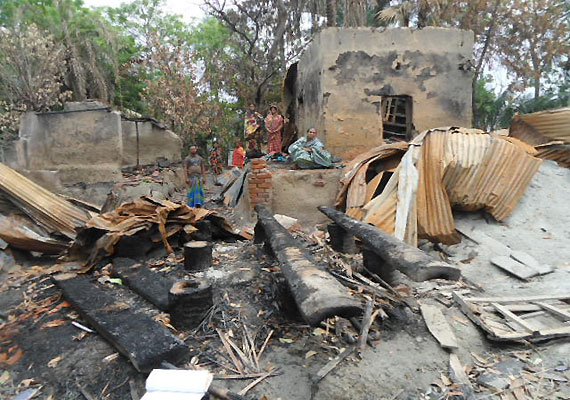
Jamaat terrorises Bangladesh Hindus, burn 6 templesActivists of Bangladesh’s largest Islamic party the Jamaat-e-Islami and its student wing, the Islami Chhatra Shibir have unleashed a streak of terror since Thursday, targeting the Hindu community in the country.
Reviving the nightmare of 1971 for minority Hindu community, Jamaat-Shibir men vandalised six temples and set fire to several Hindu houses and business in Noakhali, Gaibandha, Chittagong, Rangpur, Sylhet, Chapainawabganj and Rajganj, a Daily Star report said.
Two people were killed in the ensuing clashes between Jamaat-Shibir and the police in Datterhat and Rajganj, on Friday.
Hours after top Jamaat leader Delawar Hossain Sayedee was sentenced to death on Thursday, Jamaat activists set fire to Harishiva temple in Rajganj.
“They returned an hour later. This time we were left with no choice but to flee the area, as they started torching our houses with kerosene,” schoolteacher Shankar Chandra, who lost his house in the attack, told The Daily Star over the phone.
Some 50 Hindu people used to live in the houses burnt down, he said, adding that all but a few people had managed to escape to safety. Those left behind had been beaten up and kicked out of their houses by the Jamaat-Shibir attackers, the report said.
“We ran for our lives leaving everything behind. I was only seven during the Liberation War in 1971, but it didn’t feel this insecure even then,” said Shankar Chandra.
Jamaat-Shibir men outnumbered policemen in Rajganj as tensions continued to escalate. Just as soon as the police tried to scale down the violence, Jamaatis initiated an exchange of gunshots with the law enforcers, in which one person was killed.
They also threatened the local media from covering the event and seized cameras of photojournalists, according to the report.
In Chittagong, Jamaat activists attacked two Hindu-majority localities in Banshkhali upazila and set fire to a Buddhist temple at Satkania upazila. They also set fire to three shops belonging to Hindus at Satkania upazila and attacked people with sticks, iron rods and sharp weapons, critically injuring two, the police said.
In Gaibandha, Jamaat-Shibir men attacked a temple and business establishments belonging to Hindus on Friday. Later in the day, they vandalised houses in Shovaganj union.
Hindus also claimed that Jamaatis had vandalised, set fire to, and looted temples, houses and business establishments of the community in Sylhet, Rangpur, Thakurgaon, Laxmipur and Chapainawabganj. They also said that the Islamists had vandalised the central Kali temple in Rangpur and another in Chapainawabganj.

Stop violence against Hindus, says Bangladeshi daily

Source: IANS


Stop violence against Hindus, says Bangladeshi daily
FONT SIZE
Dhaka, Mar 4: Attacks on Hindus signify a "sinister trend" and the government must deal with the situation firmly, said a Bangladeshi daily Monday, the second day of Indian President Pranab Mukherjee's Dhaka trip that takes place amid violence over the death sentence to a top Islamist opposition leader.
"We note with a great deal of concern that the recent eruptions of political violence have been marked by some attacks on members of Hindu community with their houses and temples vandalised," said an editorial in the Daily Star.
Reports of such incidents have come from different areas of Noakhali, Chittagong, Barisal, Bagerhat and Gazipur.
"That this is very unfortunate as well as outrageous is saying the least. We condemn the perpetrators of such cowardly and despicable acts in the strongest term. The government must deal with the situation firmly to nip the sinister trend in the bud," the daily demanded.
It pointed out that since the members of minority community are vulnerable to the machinations of trouble-mongers, necessary precautionary measures should have been put in place earlier on to pre-empt any untoward incident.

"The government must fill in the gaps in its security arrangements as it cannot afford to be caught unprepared in the future. We urge the government to ensure reinforced police presence, especially in places that are inhabited by the people of minority community," the editorial said.

Mukherjee began his three-day trip Sunday. The violence cast a shadow on the Indian president's visit with opposition leader and former prime minister Khaleda Zia, who was to meet Mukherjee Monday, calling off the meeting, citing security concerns.

The daily went on to say that as a society having homogenous ethnic texture, communal harmony has traditionally been Bangladesh's hallmark. 

"So, the violence that has happened might have been a ploy of the vested quarters to smear the secular image of the country."

It demanded that the government should now stand by the victims, maintain constant vigil by law-enforcers as well as by local people to thwart any further attempt to attack them or cause communal disharmony. 

"Every specific instance of vandalism against the minority community, their houses and religious places must be probed to identify the culprits and take measures to bring them to justice. At the same time, the victims need to be compensated so that they are able to rebuild their lives," the editorial added.

Sunday, March 3, 2013

Ensure security for Hindus in Begumganj: HC

Source: Financial Express

The High Court (HC) Sunday ordered the authorities to ensure security for the Hindu community and their temples in Begumganj of Noakhali district as they were attacked by the Jama'at-Shibir activists on Thursday, reports BSS.

The bench with Justice AHM Shamsuddin Chowdhury and Justice Mahmudul Haque made this order by issuing a suo moto rule. The court also asked the concerned to reconstruct the houses, damaged by Jama'at-Shibir men.

It also asked them to explain as to why order should not be given to take proper action against persons responsible for ransacking and damaging the houses, temples and other places of worship.

Senior assistant secretary of the Home Ministry, Inspector General of Police (IGP), Deputy Commissioner and Police Super of Noakhali and officer-in-charge (OC) of Begumganj thana were asked to reply to the rule by next ten days. They were also asked to submit a progress report about compliance of court's order by this time.

The court, before issuing the order, sought opinions from three senior Supreme Court lawyers-Barrister Rokanuddin Mahmud, Advocate Abdul Matin Khasru and Advocate M Khurshed Alam Khan-who were present in the courtroom at that time.

Several newspapers and television channel published and telecast the news of ransacking and torching the houses of Hindu community people and their prayer centres by Jama'at-Shibir activists soon after the verdict was pronounced by the International Crimes Tribunal (ICT) awarding death penalty to Jama'at leader Delwar Hussain Sayedee on last Thursday.

Bangla HC orders security for Hindus in violence-hit area

Source: Znews

Dhaka: Bangladesh High Court on Sunday ordered the government to take steps for the security of the minority Hindu community in southeastern Begumganj where suspected rightwing activists attacked several temples and houses during clashes over 1971 war crimes trial in the past three days. 

"The court asked the government to take steps to ensure the minority community's security and repair their temples and houses which were damaged in the attacks," a spokesman of the attorney general's office told PTI. 
He said the High Court bench comprising judges AHM Shamsuddin Chowdhury and Mahmudul Haque issued a suo moto notice ordering the local district and police administration, the home secretary and the inspector general of police "to take proper action against persons responsible for ransacking and damaging the houses, temples and other places of worship". 
The order came as several newspapers and television channels published and telecast the news of ransacking and torching of houses of Hindus and their temples by fundamentalist Jamaat-e-Islami activists on Thursday as part of their violent campaign to thwart the ongoing trial of their leaders for 1971 war crimes. 

The reports said at least five temples and 36 Hindu houses were vandalised or torched at Begumganj sub-district of Noakhali.

HC pulls up government

Source: bdnews24.com

1 / 1
The High Court on Sunday directed the government to ensure full security for Hindu households and their temples which were attacked and vandalised on Thursday at Noakhali’s Begumganj.

 42
 5
 2      Print Friendly and PDF
RELATED STORIES
The bench of justices AHM Shamsuddin Choudhury and Mahmudul Hoque issued the suo moto rule following newspaper reports regarding the incident.

The court ordered the government to undertake repair of the houses of the affected Hindu families.

It issued a rule asking why no orders should be given to take legal measures and arrest those responsible for the attacks.

The court has asked the Senior Assistant Secretary of the Home Ministry, Inspector General of Police, the Deputy Commissioner and Superintendent of Police of Noakhali district and Begumganj Police Station Officer-in-Charge to respond to the rule within 10 days.

They would also have to submit a report on the progress of their action over the court’s direction.

Activists of Jamaat-e-Islami and Islami Chhatra Shibir on Thursday set fire to the Hindu houses and temples in Noakhali hours after Jamaat leader Delwar Hossain Sayedee was awarded death sentence by the International Crimes Tribunal-1.

Right after the verdict, leaders and activists of Jamaat and Shibir took out a procession at Begumganj upazila and then carried out the violent attacks.

Several newspapers and media outlets including bdnews24.com reported the attacks at Alampur and Aladinnagar villages at Rajganj union under the upazila.
The report said that at least 76 Hindu families lost everything in the Jamaat-Shibir rampage. “Jamaat and Shibir activists attacked 10 Hindu households of the area and set 36 houses on fire. They also vandalised and looted 53 houses there.”

The activists of the fundamentalist party, which opposed Bangladesh’s independence in 1971, vandalised and torched five Hindu temples including those at Rajganj Bazar, Thakur Barhi and Kalirhaat areas.

Crowds and justice at Shahbag

Source: bdnews224.com

Bangladesh’s quest for closure threatens to morph into the paralysing dysfunctionality that has characterized its politics. Photo: Wikimedia Commons
One of the truly significant aspects about the emotional upsurge at Shahbag in Dhaka—the hundreds of thousands of candles, the portrait of Jahanara Imam who lost her son in the liberation war in 1971 and fought for the rest of her life seeking justice—is that an overwhelmingly large number of the demonstrators are under the age of 40. Most were not born when Bangladesh emerged from its blood-soaked birth. Their fight is outwardly for an even harsher punishment (meaning death) for Abdul Kader Mullah, the Jamaat-i-Islami leader who foolishly flashed a victory sign when he was sentenced to life in prison for complicity in war crimes, and others against whom verdicts are awaited. But more fundamentally, they are trying to regain history, to assert their identity. Too often has the promise of Bangla nationalism been stolen, its national aspiration challenged, its spirit of unity based on language—irrespective of faith—reviled, its past rewritten, and the generation that fought for independence betrayed. Now it is time to reclaim the past.
For those who tuned in late: after Pakistan refused to let Sheikh Mujibur Rahman form the national government even after his Awami League had won the majority in elections, and unleashed a reign of terror in its eastern wing, hundreds of thousands of people were killed and women were raped. These criminal acts didn’t occur in isolation; pro-Islamist militia and Jamaat activists actively collaborated with Pakistani forces, leading them to the homes of nationalists, secularists, intellectuals, Awami supporters, Hindus, and others. They also participated in killing, looting, and raping. Ten million refugees arrived in India. In December 1971, Pakistan attacked India, providing India with the legal rationale to join the battle. In two weeks, Pakistani troops surrendered.
After the war, Bangladesh passed laws to try Pakistani troops and collaborators for war crimes. But India and Pakistan wanted to repatriate their prisoners-of-war, and Pakistan said it would try its officers and men who had committed war crimes. It never did, causing justified bitterness among many Bangladeshis who sought justice. A few recent memoirs of Pakistani officers admit some of the crimes, which is a small, necessary conciliatory step, but one many Bangladeshis don’t consider enough.
The assassination of Mujib in 1975 made justice more elusive. The governments that followed not only showed little interest in pursuing the collaborators, they even formed political alliances with the Jamaat, whose leadership comprised young men that most Bangladeshis say were collaborators, and in some instances, direct perpetrators. Adding to the humiliation of victims, some of the Jamaatis became ministers. The political paralysis made things worse.
While campaigning in the last elections, the Awami League promised to revive the prosecutions, and was stunned to receive a massive mandate from the young—many not born in 1971. It set up tribunals to try several accused, all except one from the Jamaat (the remaining accused is with the main opposition Bangladesh National Party, or BNP).
Justice should be firm and swift, and the trial fair. It isn’t Bangladesh’s fault that the trials could not begin for 40 years. But the trials could have been administered in a far better way. While the trials are conducted in a way that’s superior to regular criminal trials in Bangladesh, they do fall short of international standards. There have been serious questions about changed procedures. In one case, the defence has alleged that one of its witnesses has disappeared; in another case, a prosecution witness has died under mysterious circumstances; and rules and laws have been changed during the trial and now, after the verdict (allowing the appellate court to increase the sentence). And, in a sensational development, The Economist magazine revealed perplexing discussions about tactics between the judges and prosecutors with experts based abroad who had no official status. The presiding judge then resigned.
The life imprisonment verdict for Mullah had disappointed many Bangladeshis, but their simmering outrage boiled over when they saw in his “V” sign a message to his followers: wait for elections; we’ll be in coalition with the BNP, and I will be free. Calls for the death penalty for all collaborators intensified. Liberal human rights activists now face the dilemma of seeing a mass movement for justice, which they like, demanding the death penalty, which they dislike. The movement asks: if ordinary criminals get death penalty for murder, why not war criminals?
The government has hastily agreed to some demands, enraging the Jamaat youth, who rioted, vandalizing martyrs’ monuments in several cities. One blogger has been found murdered; four people have died in the violence. As the government is considering banning the Jamaat, the BNP is backing the Jamaat. The nation’s quest for closure threatens to morph into the paralysing dysfunctionality that has characterized its politics.
A dominant Jamaat will make Bangladesh look more like Pakistan, a joyless prospect Bangladeshis are rejecting loudly. But they must hold on to the principles of fair trial, and reject quick fixes and changing rules halfway. The stakes can’t get higher.